Posts tagged astronomy

Observatory Build – Part 1

0

I’ve finally got around to starting to build an observatory. After several false starts and several years of saying I must build an observatory I’m finally doing it! Finally got fed up of polar aligning etc. before observing, it will also help enormously with my asteroid accultation observations.

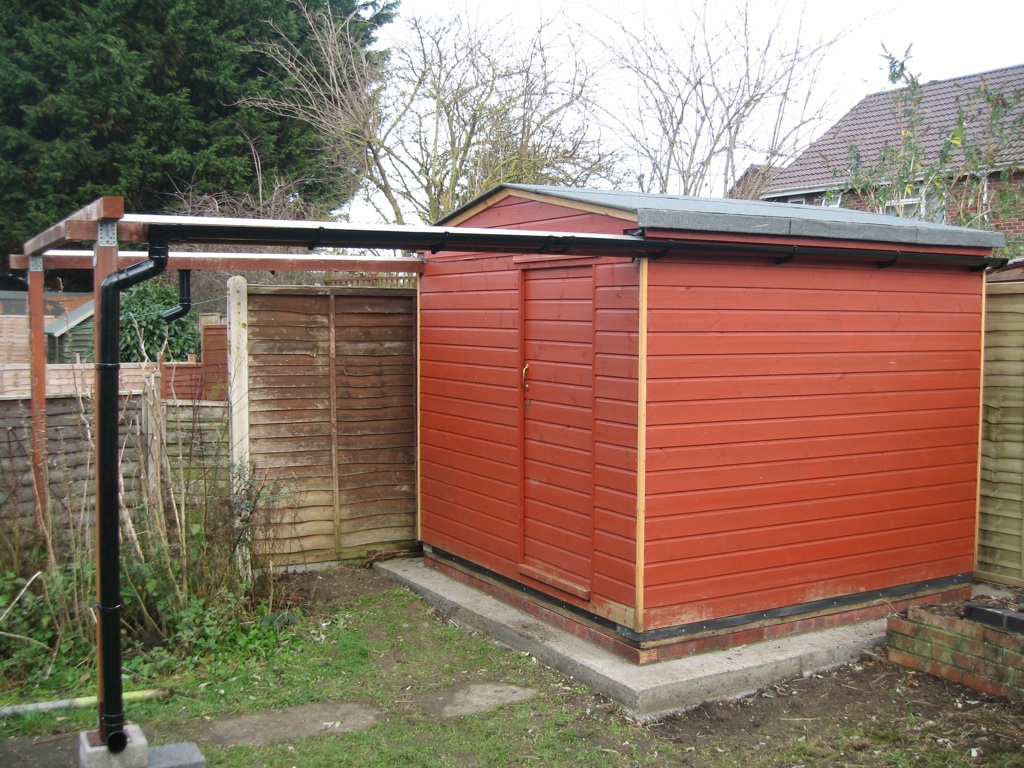
I will be building a roll-off roof observatory based upon a 8′x6′ shed. I’ll be building my own pier roughly based upon one shown in Sky & Night Magazine (http://www.skyatnightmagazine.com/feature/how-guide/how-tobuild-back-garden-telescope-pier).

The observatory will be positioned in the NE corner of my garden which is furthest from the house. This will be give me good views to the SW and W. The E horizon won’t be as good and the SE will be largely hidden, this isn’t a big problem as Didcot Power Station is only a kilometre away in that direction and is a massive light polluter. The plume from the cooling towers often obscures the NE to SE as well.

The pier will be off-centre, 3′ from the W end of the shed, the roof will roll-off to the W so I need to think about how high that will be. Electricity will be supplied from the house using a caravan lead and connectors.

This is the site before I did anything. Unfortunately this corner has become a bit of a dumping ground for previous projects and has got overgrown. The previous owners built this wall across the bottom of the garden and filled in behind with soil.

The peg is roughly where the corner of the observatory will be. The green stand roughly where the pier will be.

The first job was to remove all the vegetation and to treat the fence panels. I installed the fence several years ago and annoyingly the neighbour at the end of the garden has piled up a load of spoil against the rear panel and this will need replacing. This is how the site looked after my first afternoon of preparatory work.

You can see the large pile of soil and rubble that needed shifting! Part of the wall will need to be demolished and my temporary patio slabs lifting (they are just on the soil).

Two more afternoons and 26 rubble sacks filled with spoil and taken to the tip later and the site looks like this.

Still plenty more to shift but the worst is done. I’m going to lay a concrete base for the observatory so I will use some of the bricks from the wall as hardcore. The ground slopes to where I took the photo so there isn’t actually too much to dig out from in front of the wall. I hope to finish the groundworks over the winter and get the shed built in the spring.

I’m going to keep tabs on the total cost. So far…

  • Fence treatment = £10.99
  • Rubble sacks = £5.99
  • Pick axe = £20.98
  • TOTAL = £37.96


Imaging Jupiter – My Methodology

0

Jupiter will be at opposition (opposite the Sun in our sky) in late October. This is when it is closest to Earth and therefore largest and brightest. It’s around this time it becomes very noticeable as a bright yellowish beacon in the east as it gets dark. You cannot mistake it for any other object as it is far far brighter than any star.
This is also the time when every astrophotographer tries to get good images of Jupiter (and its four Galilean Moons). I’m no exception. I’ve taken a few images of Jupiter before but I don’t really have the right telescope for planetary imaging. Telescopes with long focal lengths (high focal ratios) are usually better and I have a short focal length widefield telescope as my main instrument.

This doesn’t deter me from trying of course and I have a DMK 21AU04.AS camera for just this job. The camera takes monochrome avi videos of whatever it sees and by taking the individual frames from the video and stacking only the very sharpest you can beat the seeing. Seeing is where the object you are watching wobbles about and flicks in and out of focus due to air currents in the atmosphere.

The other evening (24th September) I used the DMK camera, my 200mm F/4 Newtonian telescope, Astronomik RGB filters in a filter wheel and a Televue 5x Powermate to take three videos of Jupiter of 1000 frames each at 30fps. One through a red filter, one through green and one through blue. This gives a decent number of frames to work with in a not too massive file. The Powermate makes Jupiter a decent size on the imaging chip, we want to cover as many pixels as possible to get the maximum amount of detail.

By stacking the best 1/3 of the frames in Registax software I obtained three monochrome images of Jupiter. The clever bit comes when you combine these three images together, making the monochrome image taken through the red filter monochrome red, green as green and blue as blue. When you do this, as if by magic you get a colour image of Jupiter! I used Astra Image 3.0SI software to do the combining.

After creating the RGB image I did a small amount of post-processing in Astra Image 3.0SI. Deconvolution works wonders to bring out the sharpness, followed by a little curves and colour adjustment. This is mostly trial and error and personal preference, it’s easy to overdo post processing and end up with an over sharpened or too saturated image if you’re not careful.

Voila, one pretty decent colour image of Jupiter, showing details in the cloud bands and the Great Red Spot (which is actually a pale pink colour).

Jupiter

Notice the less abrupt edge to Jupiter on the right-hand side. Before opposition we are able to see slightly around to the night-side of the planet here and the cloudy atmosphere of the planet means there isn’t a sharp edge between night and day like there is on the Moon.

This is probably the best image I’ve taken of Jupiter so far helped by the exceptionally good seeing on this evening. Hopefully we will get more good evenings as opposition approaches and Jupiter gets a little bit bigger. I will be out trying to better this and/or get some satellite events too, e.g. moon shadows and transits.

Thanks to the power of twitter and retweets this image has had over 1500 views on Flickr!

‘Supermoon’

1

There have been some ridiculous news stories over the so-called ‘Supermoon’ of 19th March 2011. Especially the irresponsible one by the Daily Mail suggesting the Tōhoku earthquake of 11th March was caused by it. The only noticeable difference here on Earth will be larger than average spring tides.

This is the text of a post I made in uk.games.video.misc which sums up the facts…

You wouldn’t really notice the difference between a perigee* and an apogee* Full Moon unless they were side by side in the sky.

The Moon is always its ‘usual’ size. Sometimes a little bigger, sometimes a little smaller. Occasionally perigee coincides closely with Full Moon which is what happened on Saturday.

The difference between the extremes is 14% but usually the Full Moon occurs somewhere between apogee and perigee so each Full Moon is only a small percentage different from the next.

In fact this month’s Full Moon was just 1.08% bigger than February’s. April’s Full Moon will be just 0.10% smaller. Impossible to spot the difference. The news articles fail to mention this though!

The only thing unusual about this month’s Full Moon was how close it was to perigee, this made it the largest Full Moon since 1993, but not really anything so extraordinary. The Moon goes through perigee once a month so it always reaches its maximum apparent size at some point in the month, it just might not be full.

The Moon always appears larger when it’s close to the horizon due to an optical illusion. The Moon Illusion. The eye is fooled into thinking it’s further away and you have familiar objects close by to compare size with (e.g. houses, trees).

* the Moon’s orbit isn’t circular, it’s an ellipse. Once a month it passes through perigee (closest to Earth) and apogee (furthest from Earth).

Here is an animation showing the exact point of Full Moon for all of 2011. Notice how the Full Moons of January to April are almost exactly the same size. They then slowly decrease in size over several months. There’s no way anyone will spot the difference from month to month. It also neatly shows the libration effects, where the Moon shows a slightly different face to us as it orbits the Earth. Simulated images are from Virtual Moon Atlas.

Full Moons of 2011

The apparent size of April’s Full Moon is only a tiny fraction smaller than March’s. To all intents and purposes another ‘Supermoon’. Will we see stupid headlines about that one? I doubt it.

New Astrogallery

0

M33 - Traingulum Galaxy
OK, I’m happy to release my new Astro Images gallery now. I’m using Flickr to store images, sharing, comments etc. I’ve written a WordPress plugin which uses the JSON feed from Flickr to display the images here.

I’ve not moved all the images across to Flickr yet but I’m also having a bit of a cull as some of my earlier images, especially of Messier objects, don’t really look that good anymore. I’m planning to take better images of the objects this year. I’ve also reorganised the images into (I think) better categories.

So, over the next few weeks I’ll be putting up old, reprocessed and new images onto Flickr and they will appear in the Astro Images gallery on here.

Of course you can skip all of this and just go straight to my Flickr gallery if you want!

Partial Eclipse

0

Partial Eclipse - January 2011We had some fun trying to spot the partial eclipse. The forecast was absolutely awful so I didn’t hold out much hope of seeing it, despite this I gathered together all the equipment we were going to need for the morning.

I was somewhat surprised when the alarm woke me to find that the skies were pretty clear, I could see Venus through some thin mist and several stars. Looked good for the eclipse. So I raised the family (some were more reluctant than others) and packed my solar scope, binoculars, camera, tripod etc. into the car.

The plan was to drive to Wittenham Clumps to watch the sunrise. However, about 0.5mile north of home we drove into thick fog. Undeterred we continued in fog right to the car park at the clumps. Hopeless. So we drove all the way home again and back into partly clear skies! We parked and ran up the footpath nearby into the field behind our estate and setup with just a couple of minutes to spare.

The Sun rose, partly obscured by thin cloud but I could get some photos, everyone had a look using the telescope and solar specs. Even a couple of passing dog walkers had a look! Shortly afterwards the Sun moved into thicker cloud and was lost from view.

Very pleased to have seen the eclipse, it was worth the panic! I’ve only missed one of the last six eclipses visible from home now which is a remarkable record for the UK!

Star Camp – Autumn 2010

0

It was time for the regular Reading AS Star Camp in deepest darkest mid-Wales. We’ve been running these for 3 years now and we’ve had mixed success with the weather. One camp we had snow, one camp we drowned. But a few have been amazingly clear.

We stay on a farm that has B&B and camping. It does breakfasts and evening meals so ideal for not having to be too self-reliant. When it’s clear it is fantastically dark but when it isn’t we have a bit of a social with several bottles of red wine.

This autumn it was the latter! I just went for Saturday night as the forecast was promising and when I arrived mid-afternoon it was pretty clear. But during dinner the heavens opened and it rained on and off until around 11pm. It stayed stubbornly cloudy thereafter.

We retired to our rooms/tents. I happened to awake at 4.15am and stuck my head out of the flap of my tent and it was clear! Orion was right in front of me and of course I was already fully dark adapted. The Milky Way stretched overhead and the Pleiades blazed. I spent about 20mins taking in the sights but 4.15am is not a sensible time to be setting up telescopes and it was cold, the outside of my tent crackled with ice.

The morning was uniform grey so I must have been lucky to see a brief clear spot, the ground was white with frost. Disappointing that I didn’t get any observing/imaging done but still a good sociable occasion.

H-alpha

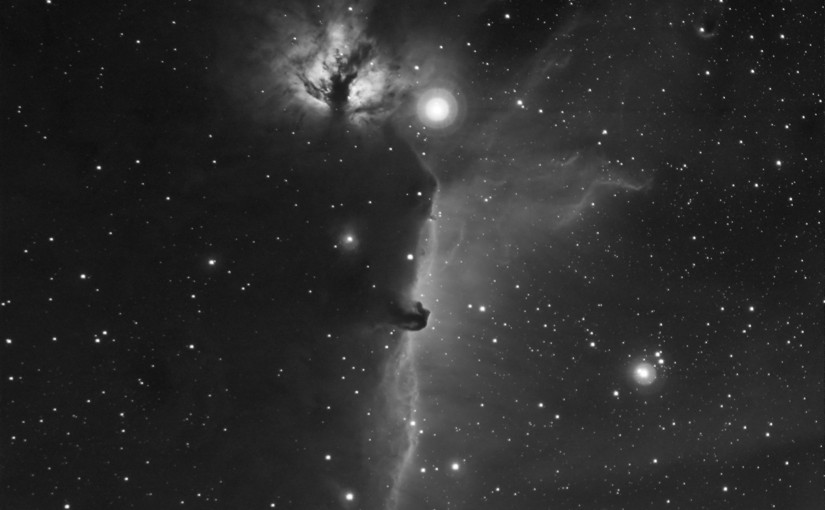
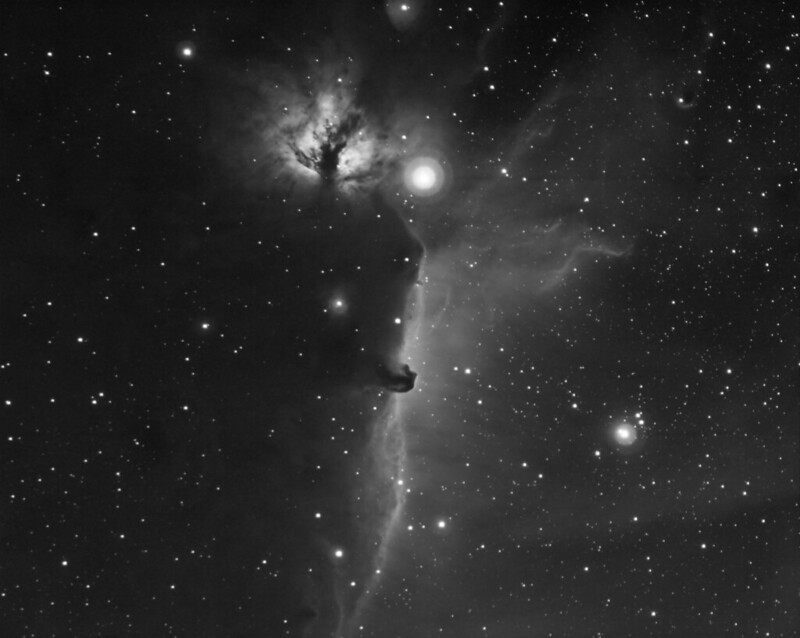
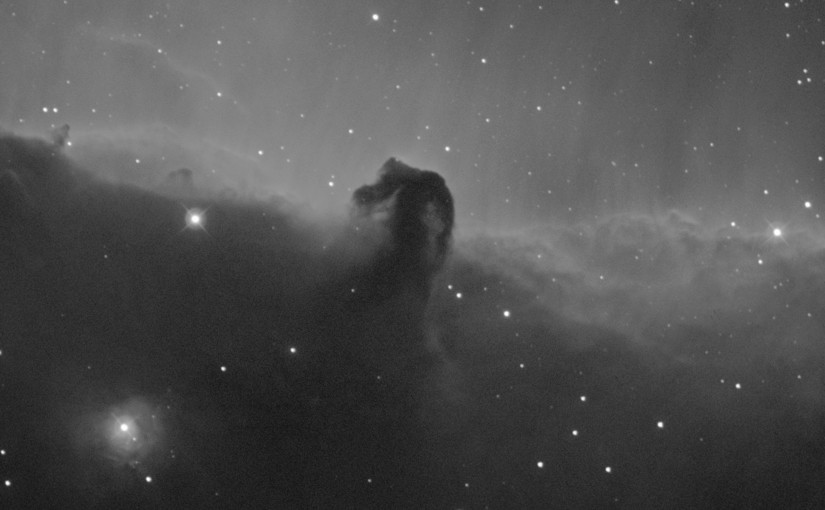
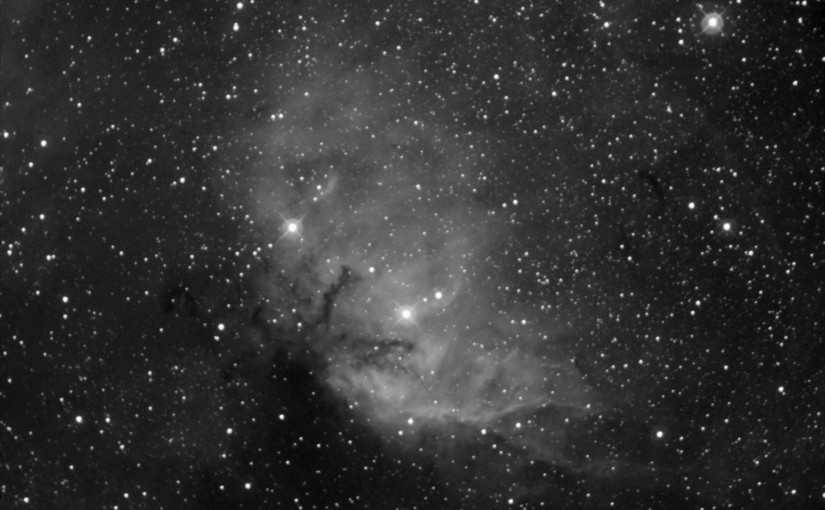
My latest astroimaging acquisition is a Hydrogen alpha filter. This filter has a very narrow bandpass and only allows light within 13nm of a wavelength of 656nm to pass through it (normal human vision at night is between 400 and 600nm). Some types of nebulae (emission nebulae, planetary nebulae and supernovae remnants) glow particularly strongly at a wavelength of 656nm due to the excitation state of the hydrogen gas in the nebula.

The advantage of using the filter is that it cuts out all light pollution and all ‘visible’ light and only allows the nebula and stars to show. The CCD chips in the cameras are sensitive to this light so you can achieve very high contrast images of nebula, impossible to achieve with filters that allow visible light through. The images are inky black where there is no nebula so even the faintest wisps can show.

Over the coming weeks and months expect to see images taken using this filter appear in the astroimages gallery.

LRGB

I’ve invested in some colour filters and a filter wheel for my astroimaging setup so I’m going to be posting some colour astroimages up over the coming months, I’ve already posted my first LRGB image of M27 into the gallery.

I thought I’d take a few words to explain how this works. The CCD camera I have is monochrome, these are generally better then singleshot colour cameras as they have a higher resolution and there are no filters in front of the chip. So to get monochrome images it’s just a case of capturing multiple exposures and stacking them in software to increase the signal to noise ratio. To get colour you need to take monochrome images through red, green and blue filters. The filters are very precisely made so they only pass through the correct wavelengths, they also block any infrared light which the cameras are sensitive to and can cause problems. They are also manufactured to ensure that they focus the light from the telescope to the same place, so you don’t have to refocus when you change filters.

The filters are held in a filterwheel, this is a mechanical device driven by batteries that rotates the filters into the lightpath at the push of a button. So there’s no requirement to dismantle the setup to put in the next filter.

So what is LRGB? An LRGB image is made up of Luminance data (monochrome), Red, Green and Blue data. What you do is capture a lot of high quality monochrome data. This provides all of the detail in the final image. You then capture some data through each of the coloured filters, this data can be with much shorter exposures and far lower quality. This colour data can then even be binned, i.e. each square of 4 pixels is summed together to make 1 pixel.  You can also blur it with a Gaussian blur filter to reduce colour noise in the final image. Software is used to combine the three images taken through the coloured filters into what looks like a blurred, low resolution colour image of the object.

Now comes the clever bit, the human eye is really good at picking out detail in monochrome images, it’s rubbish with colour. So what you do is layer the colour behind the monochrome (luminance) data. Lo and behold you have a high resolution colour image!

New Astrocam

I splashed out on a new CCD camera for astronomy this week. An Atik 16IC-S which is a 16-bit monochrome camera with peltier cooling, resolution is 782×582 pixels. The chip is progressive scan as well. This is a big improvement over the Watec I have been using, which is great for live views of objects but its 10s maximum exposure and noisy output is restrictive for deep sky imaging. The Atik can do unlimited exposures but since my telescope is not autoguiding (yet) I’m limited to about 30-60s which is about as good as my mount can do. You can see my first efforts from last night in my photo gallery. I’m thinking of splitting off the astronomy images into their own gallery by the way.

Where’s Mercury?

This morning was the conjunction of Moon, Mercury and Venus. Due to various astronomical variables which I won’t bore you with, the southern UK was not the best place to see this. However, I got up at 5.30am and drove up to Wittenham Clumps (a nearby Iron age hillfort and just about the highest point within easy reach). The sky was just starting to lighten as I walked up from the deserted car-park. There was frost on the ground and the car temperature was reading -3.5ºC. It was perfectly clear right down to the horizon.

Then I spotted the slender Moon rising, an awesome sight and started snapping off some pictures. Soon afterwards I could just glimpse Venus, easy in binoculars, but couldn’t see Mercury. I continued taking photographs at various exposures hoping that one would capture the inner planet. As the sky began to brighten I knew my chances of spotting Mercury were dwindling, especially as it was 40x fainter than Venus and I could only barely see that. I never did spot it in the binoculars. The sky was by now too bright to even spot the Moon, so I waited for sunrise about 15mins away. It was cold, very cold. And then rapidly the Sun burst above the horizon and on my hilltop perch I was the first to be basked in sunshine as the valley about lay frozen white and in shadow. A glorious experience even if I didn’t quite manage what I set out to do.

Mercury is marginally visible on one or two of my photos, I’m going to have a go at stacking them to try and bring it out. I will post any successful results here

Go to Top